What Makes a Web Application “AI-Powered”?
A web application becomes AI-powered when artificial intelligence — typically a machine learning model or a large-language-model-based AI agent — is embedded into how the application processes data and makes decisions, rather than existing as a separate add-on feature. This is a meaningful distinction from simply adding a support chatbot to an otherwise unchanged application.
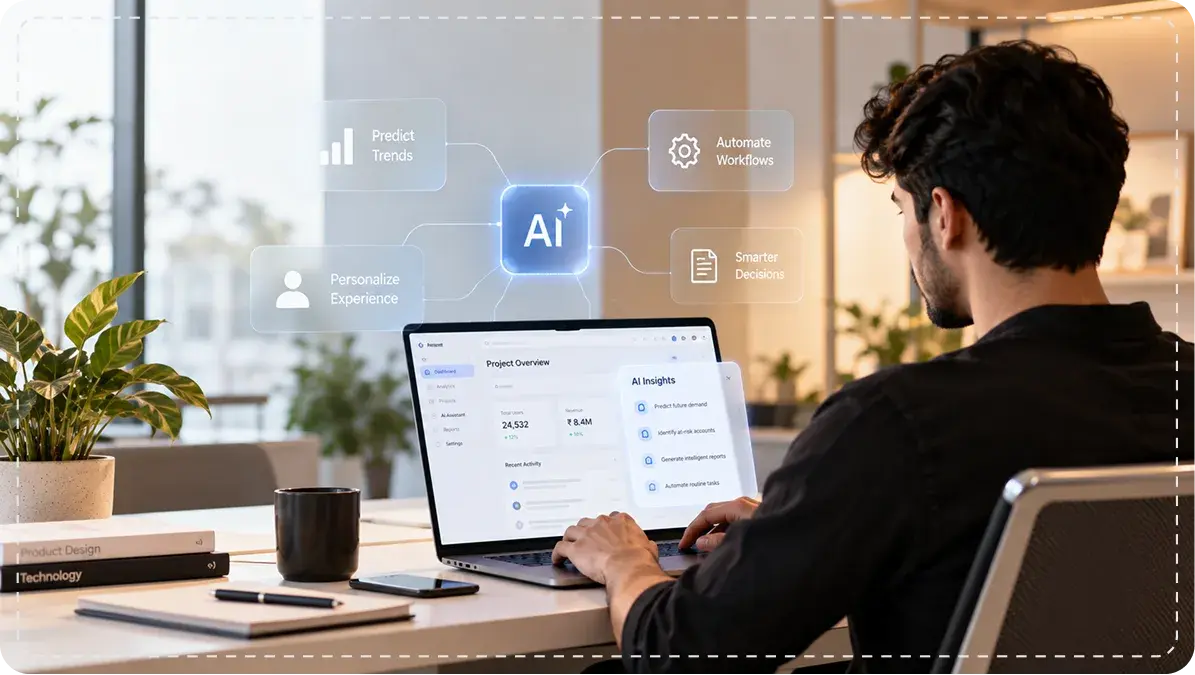
Concretely, AI-powered functionality in a web application typically falls into one of these categories:
Predictive Features
Forecasting demand, flagging at-risk accounts, estimating completion times, based on patterns in the application’s own data
Personalization
Adapting what a user sees, in what order, based on their behavior and context, rather than a fixed interface for every user
Embedded AI Agents
Components that can independently complete multi-step tasks within the application (e.g., drafting a response, reconciling a discrepancy, routing an approval) rather than only responding to direct queries
Intelligent Search and Retrieval
Understanding a natural-language query against the application’s own data, rather than requiring exact keyword matches or predefined filters
Automated Decisioning
Applying business rules combined with learned patterns to make routine decisions (approve, flag, escalate) without requiring a human to review every instance
Why Is This Happening at Such Scale Right Now?
This isn’t a marketing trend — it reflects a genuine, measurable shift in how enterprise software is being built. McKinsey’s 2025 State of AI research, based on a survey of nearly 2,000 organizations across 105 countries, found that 88% of organizations now use AI in at least one business function, and that 62% are at least experimenting with AI agents, with 23% reporting they’re scaling agentic AI in at least one function (McKinsey & Company, The State of AI in 2025: Agents, Innovation, and Transformation). Gartner’s research adds a specific application-layer data point: 33% of enterprise software applications will include agentic AI by 2028, up from less than 1% in 2024 (Gartner, June 2025).
Two forces are driving this simultaneously: the underlying AI models have become reliable and affordable enough to embed into everyday business software (not just flagship AI products), and businesses are increasingly expecting the applications they use daily — CRMs, ERPs, internal tools — to carry the same intelligence they now experience in consumer products.
What Do AI-Powered Web Applications Actually Look Like? (Examples by Function)
| Business Function | Traditional Web Application | AI-Powered Version |
|---|---|---|
| Static FAQ and ticket form | AI agent that understands the issue, checks order/account data, and resolves or routes it | |
| Manually filtered lead lists | Predictive lead scoring surfacing which accounts are most likely to convert or churn | |
| Keyword search across documents | Natural-language search that understands intent and synthesizes an answer from multiple documents | |
| Manual reorder triggers | Demand forecasting that flags reorder points based on historical and seasonal patterns | |
| Manual scheduling and dispatch | AI-assisted scheduling that accounts for technician skill, location, and job complexity automatically | |
| Manual approval queues | Automated anomaly detection flagging unusual transactions for review, approving routine ones automatically |
When Does AI Integration Actually Add Value — and When Doesn't It?
AI integration is genuinely valuable when:
- The application already handles a high volume of repetitive decisions that follow learnable patterns (approvals, categorization, routing).
- Users are currently spending significant time searching, filtering, or manually cross-referencing data the application already holds.
- The business has enough historical data for predictive or personalization features to actually learn meaningful patterns, rather than operating on too little information to be reliable.
It’s a poor fit — or at least premature — when:
- The underlying process is still unstable or poorly defined. AI features built on top of an inconsistent process tend to amplify that inconsistency rather than fix it, echoing the same lesson seen in business process automation more broadly.
- The data foundation isn’t there yet. Gartner’s own research on agentic AI project failures notes that over 40% of agentic AI projects are projected to be cancelled by the end of 2027 due to escalating costs, unclear business value, or inadequate risk controls (Gartner, June 2025) — a caution against adding AI features to an application before the underlying data and process foundation can support them.
- A simpler, rule-based feature would solve the actual problem. Not every filtering or automation need requires a learned model — sometimes a well-designed rule-based feature is faster to build, easier to explain to users, and more reliable.
Implementation Considerations for Enterprise AI-Powered Web Applications
Integration with existing systems.
AI features are only as useful as the data they can access — an AI-powered feature that can’t see your CRM, ERP, or core databases in real time will underperform regardless of the underlying model quality.
Security and data governance.
Embedding AI into an application that touches sensitive data raises the same governance questions as any other automation project — who can see what, and what audit trail exists for AI-driven decisions.
Scalability of the underlying architecture.
AI features, particularly those calling external models, need to be architected so response times and costs remain predictable as usage grows — this is an application-architecture decision, not just a model-selection one.
Human oversight for consequential decisions.
Even well-built AI features should have clear escalation paths for cases outside their confidence range, rather than full autonomy on every decision a feature touches.
Frequently Asked Questions
A chatbot is typically a single, separate feature layered on top of an otherwise unchanged application. A genuinely AI-powered web application embeds AI into its core functionality — predictive features, personalization, or embedded agents that affect how the application processes and presents data throughout, not just in one isolated widget.
In most cases, AI capabilities can be added to an existing web application through API integration with an AI model or agent framework, provided the application’s underlying architecture and data access are sound. A full rebuild is rarely required purely to add AI features.
This varies by feature type, but as a general principle, predictive and personalization features need enough historical data to reveal real patterns — a newly launched application with limited usage history is often better served starting with rule-based logic and adding AI-driven features once sufficient data accumulates.
Typically yes, at least initially — AI-powered features require additional architecture, integration, and testing work beyond a standard web application. The cost difference varies significantly based on which AI capabilities are included and how deeply integrated they are.
Per McKinsey’s 2025 research, technology, media, telecommunications, and healthcare currently lead in scaled AI agent adoption, though AI-powered features are increasingly common across nearly every industry building internal or customer-facing web applications.
Generally yes — AI features typically need monitoring for accuracy and performance over time (a practice often called model or system drift monitoring), in addition to standard application maintenance, since the underlying data and usage patterns will evolve.
It carries a different risk profile than standard features — Gartner’s research projects over 40% of agentic AI projects will be cancelled by 2027 due to unclear value or inadequate risk controls, which underscores the importance of clear scoping, governance, and human oversight rather than avoiding AI features altogether.
Conclusion
AI-powered web applications are becoming the default expectation for enterprise software, not an optional premium feature — but the specific value depends entirely on matching the right AI capability (predictive, personalization, embedded agent, intelligent search) to a genuine, well-understood business need, backed by a solid data and integration foundation. The applications getting real value from AI aren’t necessarily the most feature-heavy — they’re the ones where the AI capability solves a problem the business actually has.
If you’re scoping a new web application or evaluating where AI genuinely fits into an existing one, Image Online’s web application development team can walk through a practical assessment of where AI capability would add real value for your specific system.


 Previous