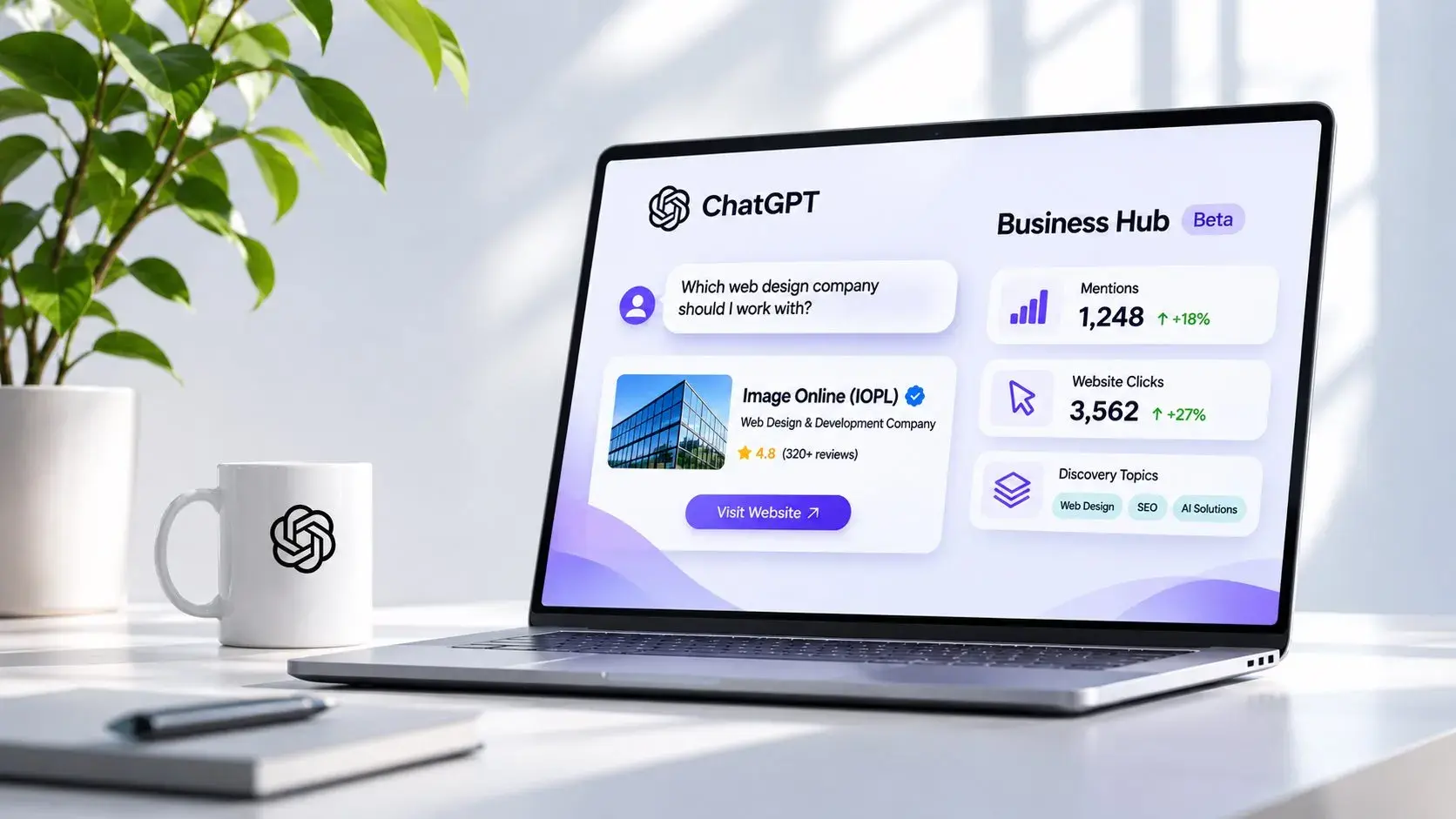
What is Businesses in ChatGPT?
OpenAI's announcement describes these pieces:
| Component | What it does | Who can use it (per OpenAI, as of 24 Nov 2026) |
|---|---|---|
| Claim a business and, once verified, update key details and add self-service product feeds with pricing and availability. Shopify merchants can connect their store from Business Hub or the Shopify admin to streamline verification. | Any eligible business located where ChatGPT is available. Existing OpenAI Enterprise customers and advertisers can work with their OpenAI representative. | |
| Aggregated insights on mentions, website clicks and discovery topics (common themes across conversations where your website is cited). Available only when conversations or interactions meet certain thresholds. | Businesses using Business Hub. | |
| After claiming, eligible organisations can build, test and launch a Business Agent. Its conversation is clearly labelled, separate from the customer's original ChatGPT conversation and distinct from ChatGPT's independent answers. It can also be sponsored and used as the destination for ChatGPT Ads. | Eligible ecommerce and online service businesses, in the US and, since OpenAI's 19 November 2026 update, outside the US. OpenAI's Business Agents policy lists eligible categories. |
OpenAI says it doesn't share users' conversations or Business Agent chats with businesses.
Why does AI-powered business discovery matter?
Because OpenAI says people are turning to AI to discover products, compare options and make decisions. OpenAI also says 1.2 billion people use ChatGPT each week. That is OpenAI's own figure, not an independent measurement.
The audience isn't the new part. What's new is that businesses can now give ChatGPT their own information and see aggregated engagement signals. OpenAI describes the aim as helping people explore products and services using the most accurate and up-to-date details.
How are customers using AI to find and evaluate companies?
OpenAI describes the intended experience like this: a business appears in a ChatGPT response, the person clicks to see its ChatGPT profile, and, if a Business Agent is available, they can start a conversation to explore its offerings and ask follow-up questions. OpenAI's own example is someone comparing products who asks about the differences between two options and which features fit their needs.
We call this emerging search behaviour because OpenAI hasn't published data on how many people use ChatGPT this way to evaluate businesses, so we don't put a number on it. If it grows, it could change how companies are found and judged in the ways below. This is our analysis of what the announced features imply, not a measured trend.
What could change for customers, and what it means for you:
From lists of links to named options in an answer:
A person asking ChatGPT may see businesses named inside the response rather than a page of results to open and compare. If so, being included in that response could become the first hurdle, ahead of where you rank.
Evaluation could start before the website visit:
OpenAI describes profiles and Business Agents where people ask follow-up questions, so part of the comparing could happen inside ChatGPT before anyone reaches your site.
Accurate, current information could matter more:
Business Hub exists so businesses can update key details and add product feeds with pricing and availability. Outdated details are something you can now correct at the source.
Your website still has to back up the claim:
A ChatGPT profile can lead people to your website, and OpenAI's insights count website clicks, so the site should match the details you provide.
Measurement could shift:
Insights report mentions, website clicks and discovery topics, so those could sit alongside rankings as signals worth tracking.
How is Business Hub different from Google Business Profile?
They do a similar job in different places.
| Google Business Profile | ChatGPT Business Hub (beta) | |
|---|---|---|
| Google Search and Maps (Google says Business Profile performance shows how customers use Search and Maps to find your profile) | Inside ChatGPT responses | |
| Not eligible. Google's guidelines say a business must make in-person contact with customers during its stated hours, and list online-only businesses as ineligible. | Eligible ecommerce and online service businesses can publish Business Agents, including outside the US (OpenAI update, 19 Nov 2026) | |
| Performance reporting: views on Search and Maps, the searches that surfaced your profile, website clicks, calls and other interactions. Only metrics that apply to your business appear. | Mentions, website clicks, discovery topics | |
| Google Ads. Google says Performance data includes activity from both organic search results and Google Ads. | Sponsored Business Agent as a ChatGPT Ads destination; sponsored placements are clearly labelled and separate from ChatGPT responses |
What hasn't OpenAI confirmed?
No ranking promise:
OpenAI's announcement doesn't say that claiming a profile or adding a product feed changes how often ChatGPT mentions your business.
It's a beta:
OpenAI says it plans to expand Businesses in ChatGPT and Business Agents to more markets and business categories over time. We haven't found a published timeline.
Sponsored placements are labelled:
OpenAI says sponsored placements are clearly labelled and separate from ChatGPT responses.
You still can't see the conversations:
OpenAI says it doesn't share users' conversations or Business Agent chats, and insights are aggregated and appear only when thresholds are met, so expect a directional signal, not lead-by-lead attribution.
What does this mean for businesses in India and Mumbai?
OpenAI says any eligible business located where ChatGPT is available can claim its business in Business Hub. In its 19 November 2026 update, OpenAI says ecommerce and online service businesses based outside the US are now eligible to claim their business and publish agents. We haven't found India-specific eligibility details, or any statement on local stores and restaurants, so the only reliable check is to try Business Hub with your own account.
How should companies prepare for AI-powered business discovery?
These steps strengthen your online visibility whether or not you can claim a profile today.
Find out what ChatGPT says about you now: Ask 15 to 20 real buyer questions, such as "best [service] company in Mumbai", "alternatives to [competitor]" and "[you] vs [competitor]". Note whether you're mentioned, whether the details are right and which sources it leans on.
Fix your entity data at the source: Your name, description, category, services, address, contact details and leadership should match across your website, Google Business Profile, Bing Places, LinkedIn and the directories that matter.
Make the website easy for machines to read: Clear service pages, crawlable content and the right structured data (Organization, Product, Service and FAQ where relevant) are essential foundations for search visibility. While OpenAI hasn't confirmed that structured data directly influences ChatGPT responses, it remains an important part of a well-structured website. As a web design and development company, we integrate these fundamentals into every website we design and develop, building digital experiences that are structured, accessible and search-ready.
Keep your product and service information in one place: OpenAI says product feeds carry pricing and availability. If your prices and stock details live in separate spreadsheets or systems, what you send to ChatGPT can end up out of date or different from your website. Using one source that your website, catalogue and CRM all read from keeps them matching. Connecting those systems is the kind of work our digital transformation services cover.
Build outside evidence: Genuine reviews, press mentions, industry directory listings and real case studies are worth building in any channel. OpenAI hasn't said how, or whether, ChatGPT uses them.
Claim and verify where you're eligible: Use an authorised person, keep a record of how verification was completed, and update everything in one pass so the profile is complete from day one.
Set a baseline before you spend: Track mentions and clicks in Insights, referral traffic from ChatGPT in your analytics, and a "how did you hear about us" field in your CRM. Only think about ChatGPT Ads once eligibility, pricing and measurement are clear.
Which businesses should act first?
| Business type | Our suggested priority | Why |
|---|---|---|
| High | Product feeds, the Shopify connection and Business Agents fit directly. | |
| Medium to high | Accurate business details in Business Hub, plus a Business Agent if you're an eligible online service business. |
What mistakes should companies avoid?
- Treating profile claiming as a ranking shortcut.
- Buying packages that promise "ChatGPT rankings" with no way to measure them.
- Letting website, directory and social details contradict one another.
- Waiting for the feature to be "final" before cleaning up data that needs fixing anyway.
- Skipping measurement, then having no answer when someone asks whether it worked.
Frequently Asked Questions
Business Hub is a beta that gives businesses a new way to provide information to ChatGPT. Treat the profile as one more place your business data lives, and keep your Google, Bing and directory listings accurate.
OpenAI's announcement doesn't say so. It says claiming lets you update key details, add product feeds and see insights on mentions and website clicks. Be wary of anyone promising better recommendations from claiming alone.
Possibly. OpenAI says any eligible business located where ChatGPT is available can claim, and its 19 November update says ecommerce and online service businesses based outside the US are now eligible to claim and publish agents. We haven't found India-specific eligibility details, so try it with your own account.
OpenAI describes aggregated insights on mentions, website clicks and discovery topics, meaning common themes across conversations where your website is cited. They appear only when conversation or interaction thresholds are met, and OpenAI doesn't share users' conversations. Think of it as a directional signal, then pair it with your own analytics and a CRM source field.
OpenAI names ecommerce and online service businesses for Business Agents, and Shopify merchants can connect their store from Business Hub. Product feeds carry pricing and availability, so if your product data sits in scattered spreadsheets, tidy that before you publish any feed. The catch is that it's a beta and OpenAI says eligibility will expand over time, so what applies today may change.
Only if you're eligible. OpenAI says Business Agents are available to eligible ecommerce and online service businesses, and since 19 November 2026 that includes businesses outside the US. Sponsored placements are labelled, and OpenAI doesn't share agent chats with businesses. Run a small pilot with a capped budget and one success metric.
OpenAI describes ChatGPT's answers as independent, and it hasn't published how ChatGPT chooses which businesses to mention, so we can't promise what influences it. Keeping your website, structured data and directory listings consistent is sound practice. Re-run your buyer-question audit monthly and fix inconsistencies where they start.
OpenAI hasn't published how ChatGPT decides which businesses to mention, so we can't say how much traditional SEO carries over. Accurate, consistent business information and a crawlable website are sensible foundations, and measurement here shifts to mentions, website clicks and referral traffic. We see it as an extension of the SEO and GEO work that sits within digital marketing services, not a separate discipline.
Where we come in?
Choosing the right web application and development company goes beyond creating an attractive website. It involves building a digital foundation that supports business growth, improves online visibility and connects different aspects of your digital operations. At Image Online, we design and develop websites for clients across the globe. We also offer digital marketing services and digital transformation services, bringing your website, data and marketing efforts together through an integrated approach.
For paid campaigns, our approach focuses on no media commission, complete budget transparency and CRM-enabled dashboards. This allows businesses to track campaign performance and understand the actual returns from every channel, including emerging platforms such as ChatGPT Ads as they become available. As AI assistants become another way for customers to discover and evaluate businesses, understanding how your brand appears across these platforms is increasingly important. We can help assess your current AI visibility, identify gaps and create a practical roadmap for improvement.
Sources: OpenAI, Introducing Businesses in ChatGPT · Google, Business eligibility and ownership guidelines · Google, Understand your Business Profile performance and insights


 Previous